
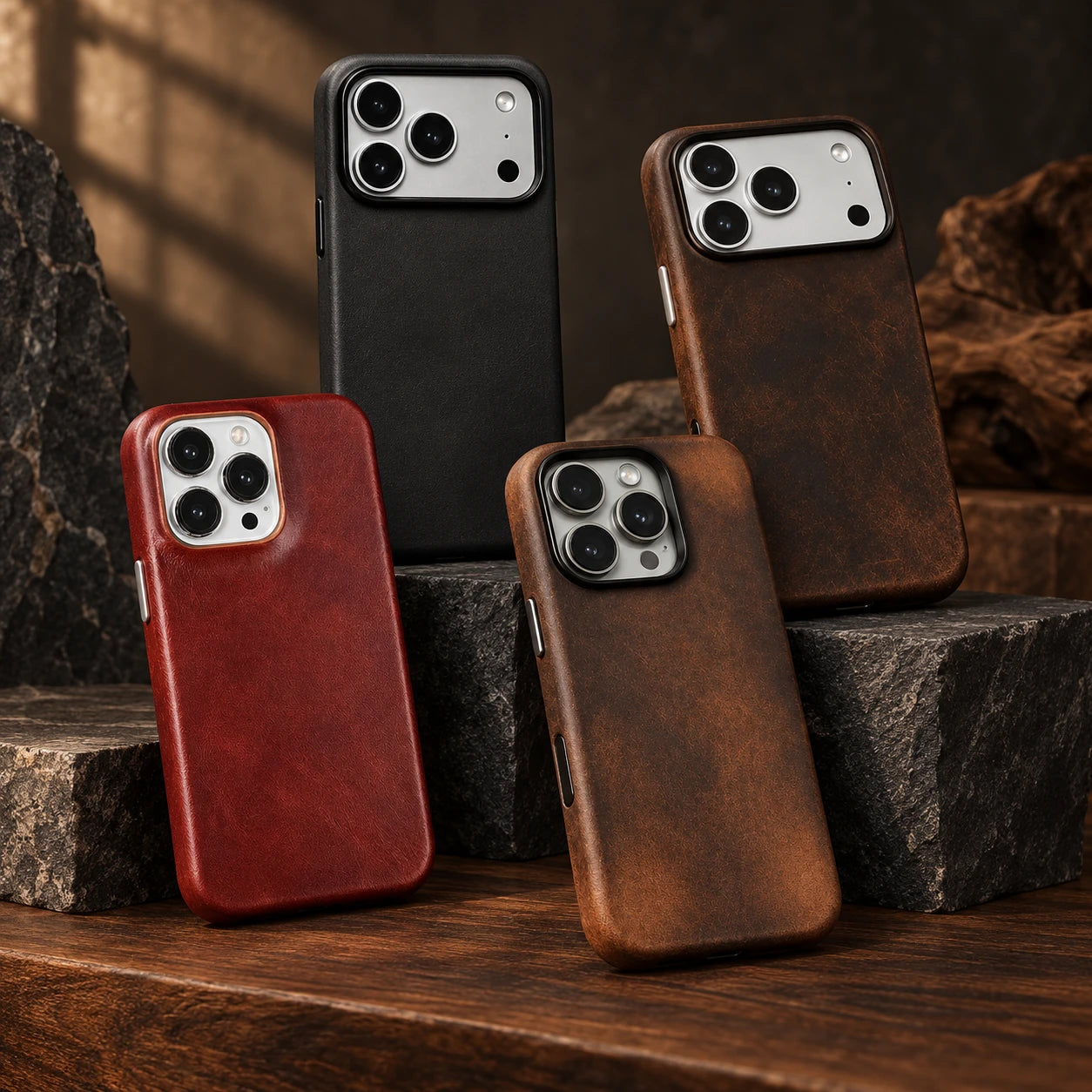
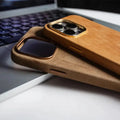
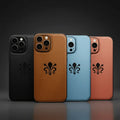
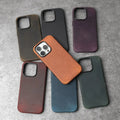
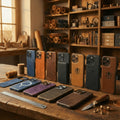
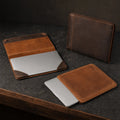

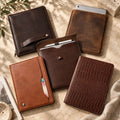


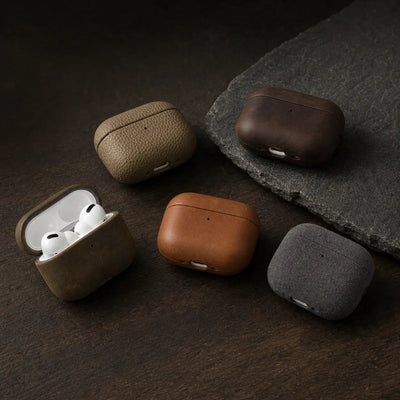
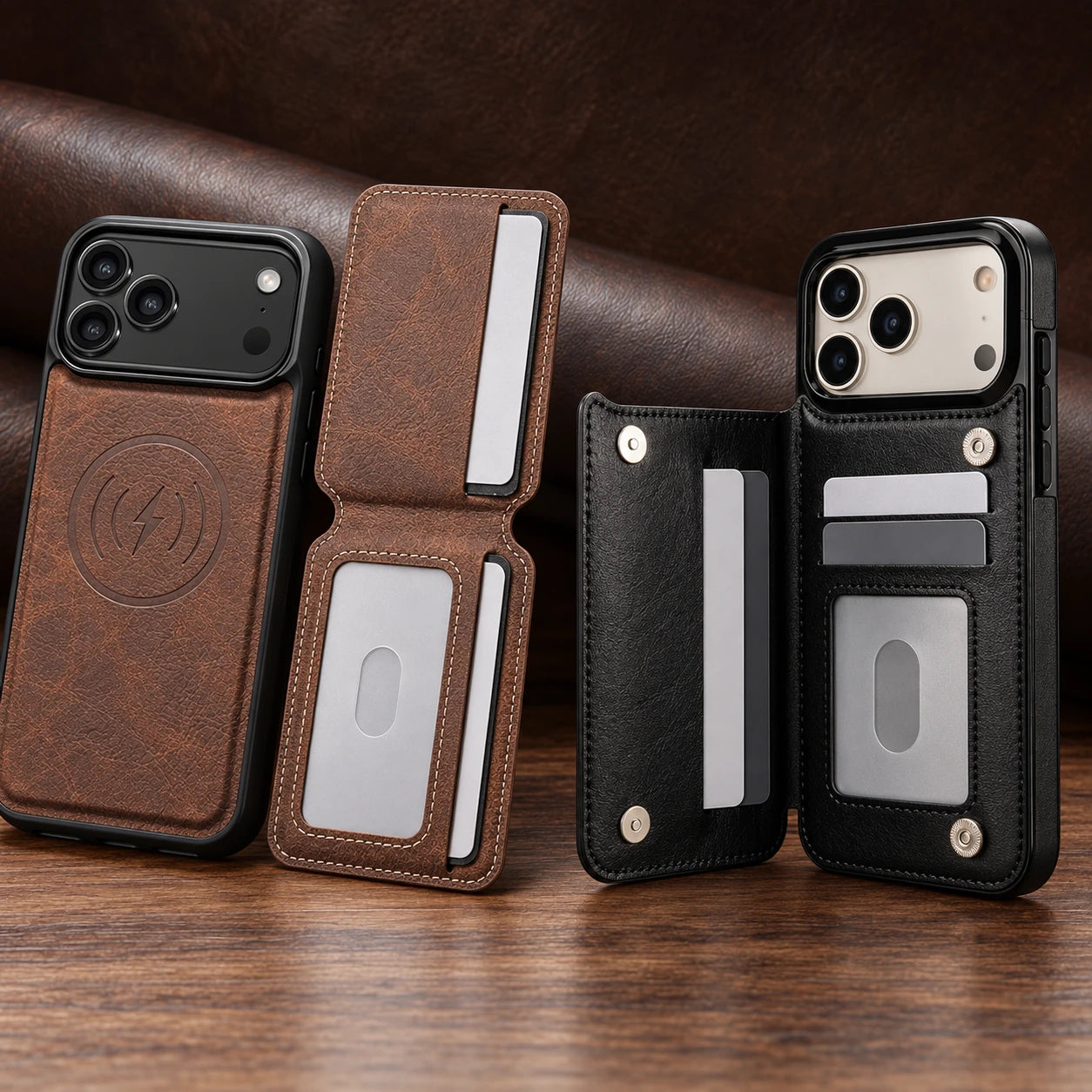

Full-grain, top-grain and genuine leather are the three labels you see most often on leather goods, and they are often used as if they meant the same thing. They do not. Each one tells you something different about which part of the hide was used and how much of its natural surface is left.
That matters more on a phone case than on most things you own. You hold it all day, so the surface decides how it feels, how strong it is and whether it will age into patina or simply wear. This guide explains the three labels plainly, shows how to check them, and covers the confusing ones in between.
Full-grain leather is the outer layer of the hide with its natural surface left intact: the strongest layer and the one that develops patina. Top-grain is the same outer layer with the surface sanded and coated to look uniform. "Genuine leather" only tells you the material is real hide; on its own it does not say which layer or quality, and it is often used for lower layers.
- These labels describe layers of the hide and how much natural surface is left. They say nothing about colour or finish.
- Full-grain keeps the whole outer surface: the tightest fibres, the most character, and real patina.
- Top-grain is sanded and coated: even and stain-resistant, but it changes less and feels less natural.
- "Genuine leather" means real hide, but it is not a grade. Look for the grade word next to it.
- Vegan leather is synthetic (PU), not hide, and is not any of the three.
How is a hide divided into layers?
A cowhide is thicker than any phone case needs, so tanneries split it into layers. The outer side, where the hair grew, is called the grain. Its fibres are fine and tightly packed. Further down, the fibres become looser and weaker.
The upper layer, with the grain on it, becomes full-grain or top-grain leather. The lower layer is called a split. Everything else on the label follows from one question: how much of that original grain is left?
Grade and finish are separate things. Crazy Horse, for example, is a finish and not a grade, and not an animal either: the hide is cow. A Crazy Horse finish can sit on full-grain leather, which is how it works on our Ferrara. Our guide to Crazy Horse, oil-wax, pull-up and Nappa explains the finishes.
What is full-grain leather?
Full-grain leather keeps the outer surface of the hide as it grew. Nothing is sanded off and nothing is printed on top. You can see its pores, fine creases, tonal shifts and the small healed scars the animal had.
Because the tightest fibres are still there, it is the strongest and most durable layer. Because the natural surface is still there, it is also the layer that takes in oils from your hands, darkens in daylight and burnishes with friction. That is what people call patina.

The trade-off is honesty. Full-grain leather shows marks, and no two pieces look exactly alike. Our product pages say it plainly: small scars, pores and colour variation are normal and prove it is real leather, not synthetic.
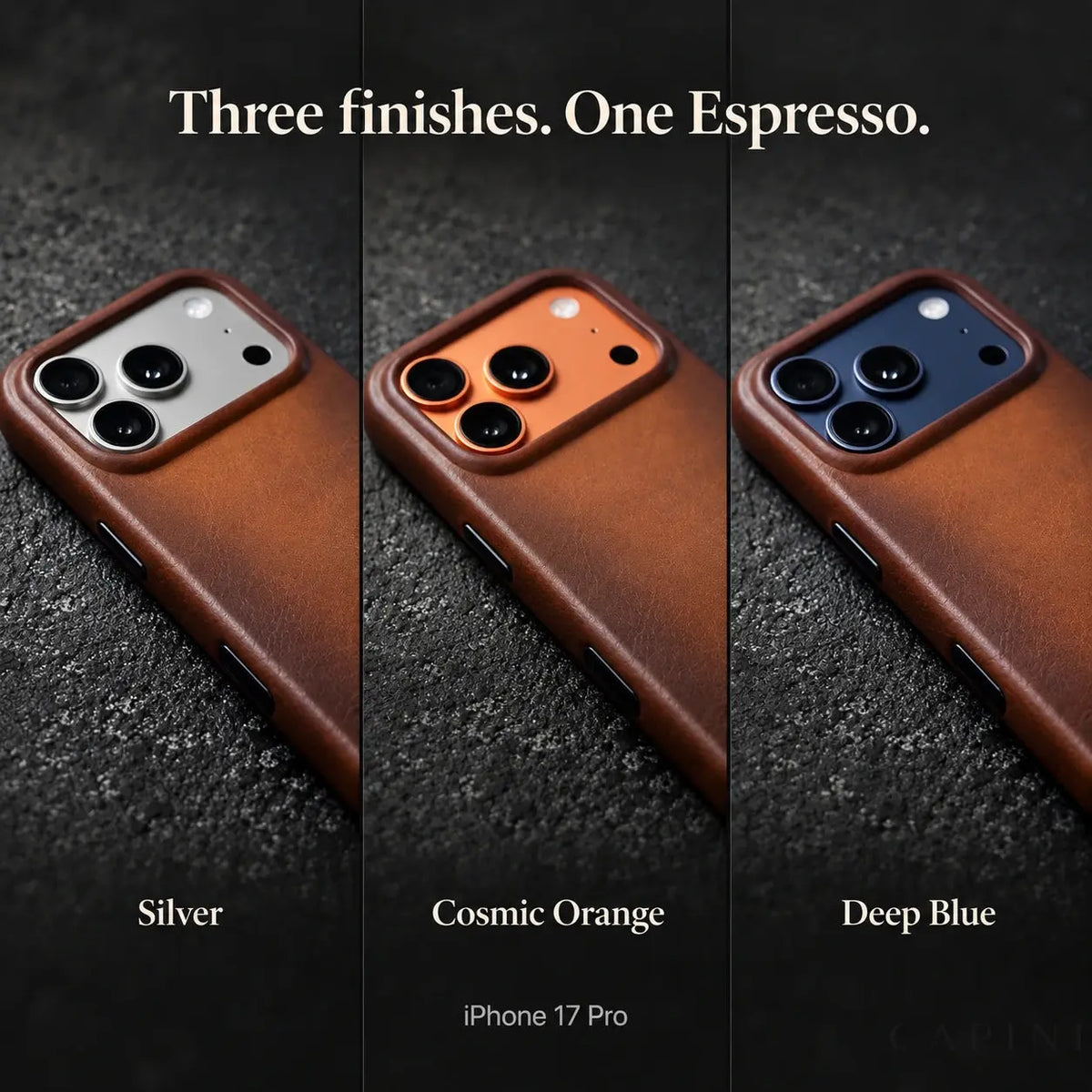
Among our pieces, the Ferrara, Siena, Parma, Lucca, Torino, Bologna and Milano Lanyard cases and the Cremona strap are all described as full-grain on their pages.
What is top-grain leather?
Top-grain comes from the same upper layer, but the surface has been sanded or buffed to remove marks. It is then usually finished with a pigmented coating, and often embossed with an artificial grain pattern. You may also see it called corrected-grain leather.
The result is even, consistent and resists stains well. It is also slightly thinner and more flexible. What it gives up is the natural surface: it develops much less patina, feels cooler and smoother in the hand, and the coating can wear through over the years instead of ageing.
One label causes real confusion. Some product descriptions use "top-layer" or "first-layer" leather. That is not the same as top-grain. It means the outer layer of the hide, the full-grain side. Our Cremona strap, for example, is "full-grain top-layer cowhide", and our Parma is "first-layer full-grain". Read the words together, not one at a time.

What does "genuine leather" mean?
"Genuine leather" tells you the product is made of real animal hide, not a synthetic. That is all it tells you. It says nothing about which layer of the hide was used or how it was finished.
In everyday retail, the label is often used on lower-grade leather, frequently a split with a painted and embossed surface. That is why it has a poor reputation. But the words themselves are not a warning sign. What matters is whether a grade word sits next to them.
Several of our pages say "full-grain genuine leather" or "full-grain genuine cowhide". "Genuine" confirms it is real hide. "Full-grain" tells you the grade. If a product only says "genuine leather", it is fair to ask which layer it is.

Full-grain vs top-grain vs genuine leather, side by side
| Full-grain | Top-grain | "Genuine leather" (alone) | Vegan leather | |
|---|---|---|---|---|
| What it is | Outer layer, surface intact | Outer layer, surface sanded and coated | Any real hide, often a lower layer | Synthetic (PU), no hide |
| Surface | Natural grain, pores, small scars | Even, uniform | Varies, often embossed | Moulded, uniform |
| Strength | Highest | High | Varies | Depends on the material |
| Patina | Yes | Little | Usually little | None |
| In a year | Deeper colour, softer sheen | Much the same, coating may wear | Depends on the layer | Same colour |
How can you tell which leather a phone case uses?
You cannot always be certain from a photo, but these checks get you most of the way.
- Read the full material line. Look for the word "full-grain". "Genuine" or "real leather" alone is not a grade.
- Look at the surface in good light. Pores, fine creases, small healed marks and shade variation point to a natural grain. A perfectly regular, repeating texture usually means a corrected or embossed surface.
- Touch it. Full-grain feels warm and slightly irregular. Depending on the finish it may feel waxy or dry. A thick coating feels smooth and cool, closer to plastic.
- Press and bend it. On oil- and wax-rich full-grain leather, the colour lightens where it bends. A coated surface barely changes.
- Give it a few weeks. Full-grain changes with use. A coated surface looks much the same in a year.
One test to avoid: the water drop. Waxed full-grain leathers such as Crazy Horse also repel a drop of water, so it tells you about the finish, not the grade.

What about split, suede, bonded and vegan leather?
- Split leather is the lower layer of the hide. It is often made into suede, or coated and embossed to look like grain leather.
- Suede has a napped, velvety surface, usually from the inner side of a split. Nubuck looks similar but is made by buffing the grain side.
- Bonded leather is made from leather scraps and fibres bound together with an adhesive onto a backing. It is the lowest grade and tends to peel.
- Vegan leather is synthetic, usually polyurethane (PU), and contains no animal hide. Our Lecce AirPods case is vegan leather, and we say so on the label. It holds its colour and does not develop patina.
- Alcantara is not leather at all. It is an Italian microfibre with a suede-like feel.
For how leather, Alcantara and vegan leather compare as phone cases, see leather, Alcantara or vegan leather.
Which should you choose for a phone case?
- You want a case that ages and becomes yours: full-grain. Then choose the finish, from fast-changing Crazy Horse to quiet Nappa.
- You want a uniform look that stays the same: a corrected, coated leather, or a material that is not leather.
- You want no animal hide: vegan leather, which is synthetic, or Alcantara. Browse our vegan leather collection.
Whichever you choose, the protection comes from the shell underneath, not the grade of the leather. If you want to know how a full-grain surface will change, read what patina is. To compare our cases, see all iPhone cases.
Frequently asked questions
Is full-grain better than top-grain?
For a case you want to age with you, yes: it is stronger and develops patina. Top-grain is a reasonable choice if you prefer a uniform look that stays the same.
Is genuine leather real leather?
Yes. It is real hide. But the label alone does not tell you which layer or quality it is.
Is "top-layer" leather the same as top-grain?
No. "Top-layer" or "first-layer" means the outer layer of the hide, which is the full-grain side. "Top-grain" usually means that layer with its surface sanded and corrected.
Is Crazy Horse full-grain?
Crazy Horse is a finish, not a grade. On our Ferrara it is applied to full-grain cowhide tanned by Mastrotto in Italy.
Does full-grain leather scratch more easily?
It shows marks more readily, because nothing covers the surface. On waxed and oiled full-grain leathers, light scratches can blend back in with warmth and use.
Is vegan leather a type of genuine leather?
No. Vegan leather is synthetic and contains no animal hide. Genuine leather is always real hide.
Which grade is Nappa?
Nappa describes a soft, smooth leather and its finish rather than a layer. Check the material line for the grade. Our Napoli page describes it as Italian Nappa leather.
Written by the Capini Firenze team. We work with these leathers every day and update this guide when our materials change.

Leave a comment
This site is protected by hCaptcha and the hCaptcha Privacy Policy and Terms of Service apply.