









In the Museo del Violino in Cremona, on Piazza Marconi, a musician sits down with a historic instrument from the collection and plays it. The series is called Il suono di Stradivari, the sound of Stradivari, and it runs through the year. The instruments are not only kept behind glass. They are still played.
Our leather Apple Watch strap is named after this city. It is named after it, and its leather does not come from there. Cremona gives the strap a name and a way of thinking: chosen materials, time, and use.
Our Cremona strap is named after Cremona, the city in Lombardy whose violin-making UNESCO recognised in 2012 and sums up in one line: "No two violins are alike". The city is the name, not the origin. We borrowed the idea of a material chosen with care that changes with use: full-grain cowhide with a vintage Pull-Up finish, which lightens where it bends and darkens where you touch it.
- Cremona names the strap. The city gives it a name and an idea, not an origin.
- UNESCO inscribed traditional violin craftsmanship in Cremona in 2012.
- Antonio Stradivari (1644–1737) worked in Cremona. His "Gould" violin of 1693 is at the Metropolitan Museum of Art.
- The Torrazzo's astronomical clock dates from the 16th century and still works.
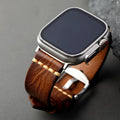
- The strap: full-grain top-layer cowhide, Pull-Up finish, 24mm wide, for 40mm to 49mm cases, no tools needed.
Why is Cremona called the city of violins?
Because violin-making is not a sideline there. In 2012, UNESCO inscribed traditional violin craftsmanship in Cremona on its list of the intangible cultural heritage of humanity. The inscription says the craft is considered fundamental to the identity of Cremona and its citizens.

The craft lives on through two associations of makers, the Consorzio Liutai Antonio Stradivari and the Associazione Liutaria Italiana. The city itself calls it Saper fare liutario di Cremona, the know-how of Cremona's violin-making, and keeps a formal plan to safeguard it.
That is the first thing worth knowing about Cremona. It does not treat the violin as a souvenir. It treats it as a skill to be passed on.
What does "no two violins are alike" mean?
It is UNESCO's own phrase, and the sentences that follow explain it. Every part of the instrument is made with a specific wood, carefully selected and naturally well seasoned. No semi-industrial or industrial materials are used.

In other words, the difference between two violins starts with the material. Two pieces of wood are never quite the same, so two instruments are never quite the same either.
You will often read about a "secret varnish". We found no primary source for it, so we leave it out. UNESCO speaks of chosen wood and method, not of a secret.
A note on names, because it is often wrong. The maker was Antonio Stradivari. The Latin form of his name appears on the labels inside his instruments, which is why you also see it spelled with a final "us".
Where can you see a Stradivari today?
One of the clearest examples is in New York. The Metropolitan Museum of Art holds the "Gould" violin, made by Antonio Stradivari in 1693. The museum gives his dates as Cremona 1644–1737. The violin was a gift of George Gould in 1955, and its woods are listed as maple, spruce and ebony. The Met also holds the "Francesca", a Stradivari violin of 1694.

In Cremona itself, the Museo del Violino on Piazza Marconi brings the craft back home. Its collection includes a viola by Girolamo Amati from 1615, a Stradivari violin from around 1668 known as the "Golden Bell", and an instrument by Carlo Bergonzi from around 1739. Concerts take place in the museum's Auditorium Giovanni Arvedi.
| Instrument | Maker | Date | Where |
|---|---|---|---|
| Viola | Girolamo Amati | 1615 | Museo del Violino, Cremona |
| Violin, "Golden Bell" | Antonio Stradivari | c. 1668 | Museo del Violino, Cremona |
| Violin, "Gould" | Antonio Stradivari | 1693 | Metropolitan Museum of Art, New York |
| Violin, "Francesca" | Antonio Stradivari | 1694 | Metropolitan Museum of Art, New York |
| Instrument | Carlo Bergonzi | c. 1739 | Museo del Violino, Cremona |
More than three centuries separate some of these instruments from today. They were built to be used, and they have outlasted everyone who first played them.
How does Cremona keep time?
With a clock that has been running for centuries. The heart of the city is the Piazza del Comune, where the Duomo, the Baptistery and the Torrazzo stand together. The Torrazzo is the cathedral's bell tower.

The city describes it as famous for its astronomical clock, a masterpiece of engineering and mechanics built in the 16th century and still working. Inside the tower is the Museo Verticale, a museum dedicated to astronomy and the measurement of time.
For a piece that holds a watch, we liked that. A city that has kept time with the same machine since the 1500s is a fitting name for something you put on every morning to tell the time.
What else is Cremona known for?
A city of makers is usually a city of musicians and cooks too.

- Monteverdi. The composer Claudio Monteverdi was born in Cremona in 1567 and baptised on 15 May in the church of Santi Nazaro e Celso. He was the son of a physician, Baldassarre, studied with Ingegneri, and died in Venice in 1643.
- Torrone in November. The Festa del Torrone takes over the historic centre; in 2026 it ran from 7 to 22 November, with giant torrone constructions, the Torrone d'Oro, and a re-enactment of the wedding of Bianca Maria Visconti and Francesco Sforza. The city tells that torrone was born at that wedding in 1441. It is a story the festival re-enacts, not a documented fact.
- Food with a protected name. The Comune keeps a list of local specialities under its De.Co. label, including marubini, mostarda, torrone, the Torta Bertolina, the Torta Turunina and Salsiccia di Cremona.
- Lombardy, not Emilia. Cremona is in Lombardy, as UNESCO's own listing says. It is also not Crema, a different town in the same province.
What does a city of violins have to do with a watch strap?
Not the making. The strap is not made by a violin-maker, and the leather is not from Cremona. We would rather say that plainly than let the name suggest it.

What we borrowed is the idea in UNESCO's sentence: start with a material chosen for what it will become, and let use do the rest. A violin is made to be played, year after year. A good leather strap is made to be worn the same way, and to look more like yours each year.
Full-grain leather keeps the surface the animal grew: its grain, its tone, its small natural marks. Nothing is sanded off and nothing is printed on top, so no two hides read exactly alike. Our guide to full-grain vs top-grain vs genuine leather explains why that layer matters.
What is the Cremona strap made of?
- Leather: full-grain top-layer cowhide, the strongest layer of the hide, with a vintage Pull-Up finish.
- Colour: antique brown, with contrast saddle stitching.
- Size: 24mm wide, 4mm thick, 125mm + 75mm long.
- Buckle: brushed, in silver or matte black.
- Connectors: stainless steel, sliding straight into the watch case, with no tools and no adapters to buy.
- Fits: 40/41mm, 42mm (Series 10), 44/45/46mm and 49mm Ultra cases; Series 4 through the latest, SE, and Ultra / Ultra 2.
Pull-Up leather is meant to move. Bend it and the colour lifts; wear it and it settles back darker. Over months it develops a patina, the record of how you wear it. Our article on leather patina explains how it forms.

How do you wear, match and care for it?
First, check your case size against the list above. The 42mm size needs care: the earliest Apple Watch models had a larger 42mm case, while the strap page lists the newer 42mm of Series 10. If in doubt, write to us before you order. Our guide on how to choose an Apple Watch strap covers sizing in detail.
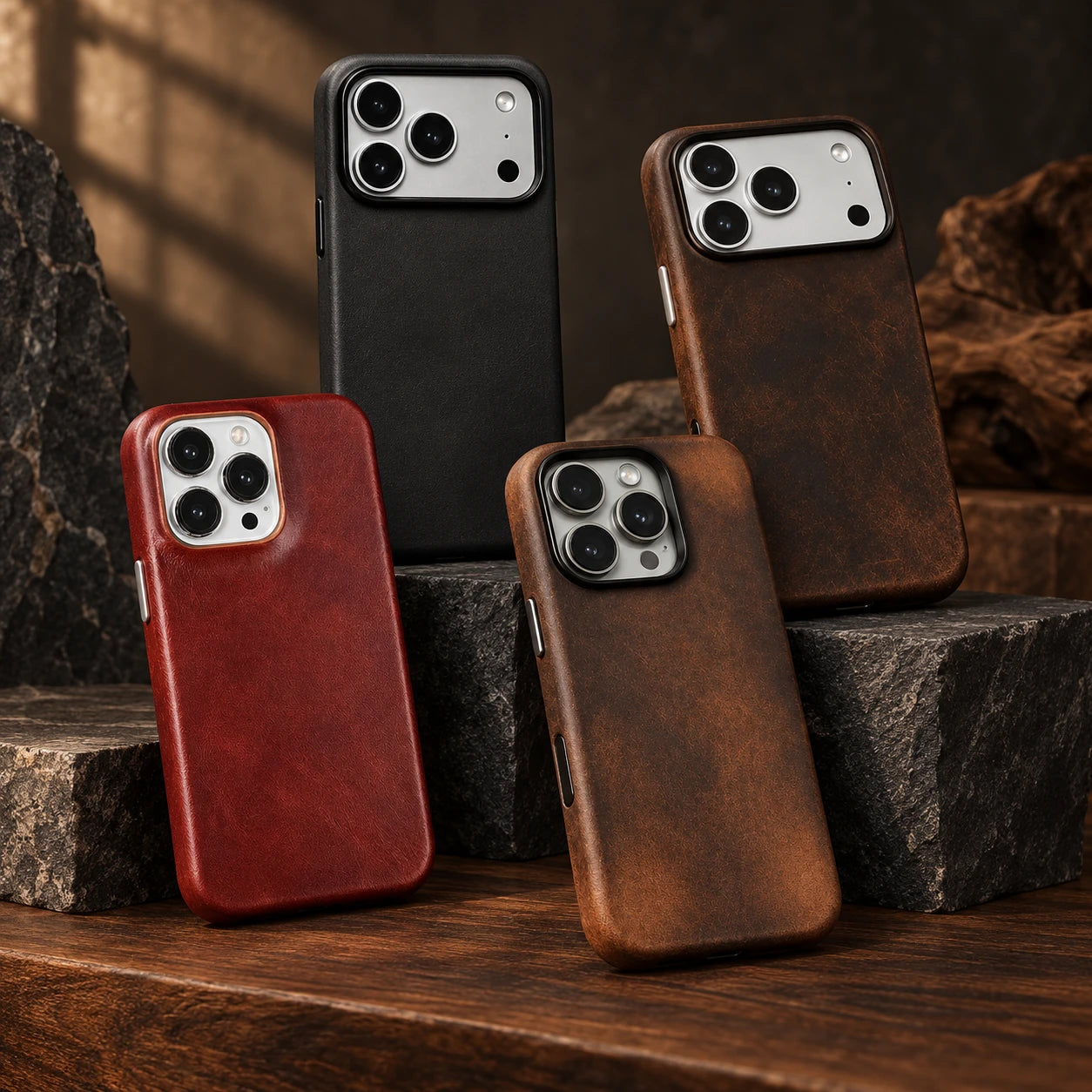
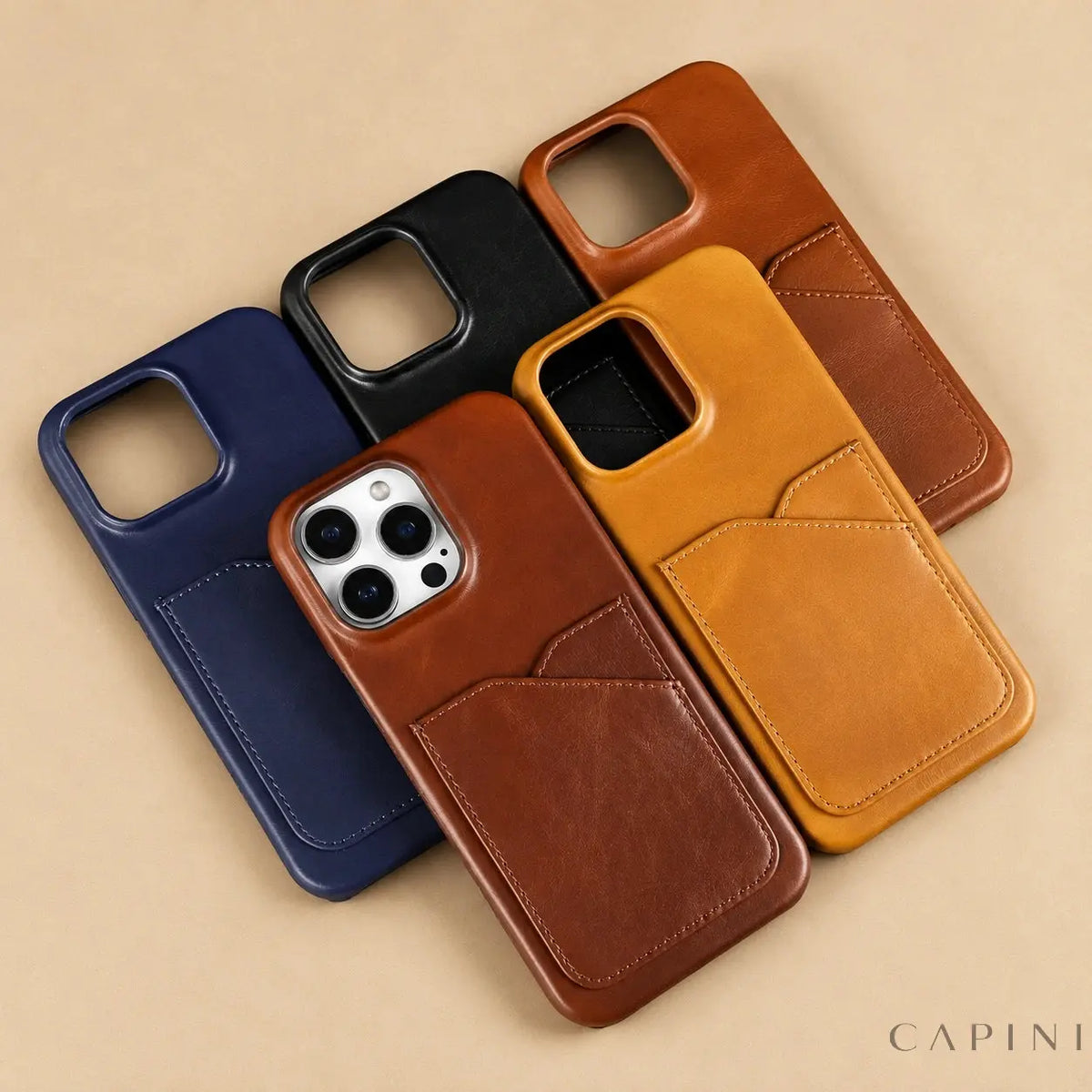
Then match the finish, not only the colour. Two browns in different leathers can look alike on day one and very different by spring. Cremona pairs naturally with the Parma iPhone case, also full-grain cowhide with a Pull-Up finish, so both change in the same direction. Choose the silver or black buckle to match your watch case.

Care is short. Wipe it with a dry cloth. Take it off before swimming or the shower: real leather and long soaks do not get along. If it gets wet, let it dry at room temperature, never on a radiator. For workouts, a textile strap is the better tool.
See all our Apple Watch straps, or put a strap, case and AirPods case side by side in Build your set. For the other side of this series, read why our Nappa case is named after Naples.
Frequently asked questions
Why is the strap called Cremona?
After the city of violins. Cremona gives the strap a name and an idea, not an origin.
Is the Cremona strap real leather?
Yes. It is full-grain top-layer cowhide with a vintage Pull-Up finish.
Which Apple Watch sizes does it fit?
40/41mm, 42mm (Series 10), 44/45/46mm and 49mm Ultra. It fits Series 4 through the latest, SE, and Ultra / Ultra 2.
Do I need tools to fit it?
No. The stainless steel connectors slide straight into the watch case.
Can I wear it in the shower or the pool?
No. Take it off first. Long soaks are hard on any real leather.
Will the colour change?
Yes. Pull-Up leather lightens where it bends and darkens where you touch it. That change is the point.
Written by the Capini Firenze team. We work with these leathers every day and update this guide when our materials change.

Leave a comment
This site is protected by hCaptcha and the hCaptcha Privacy Policy and Terms of Service apply.