
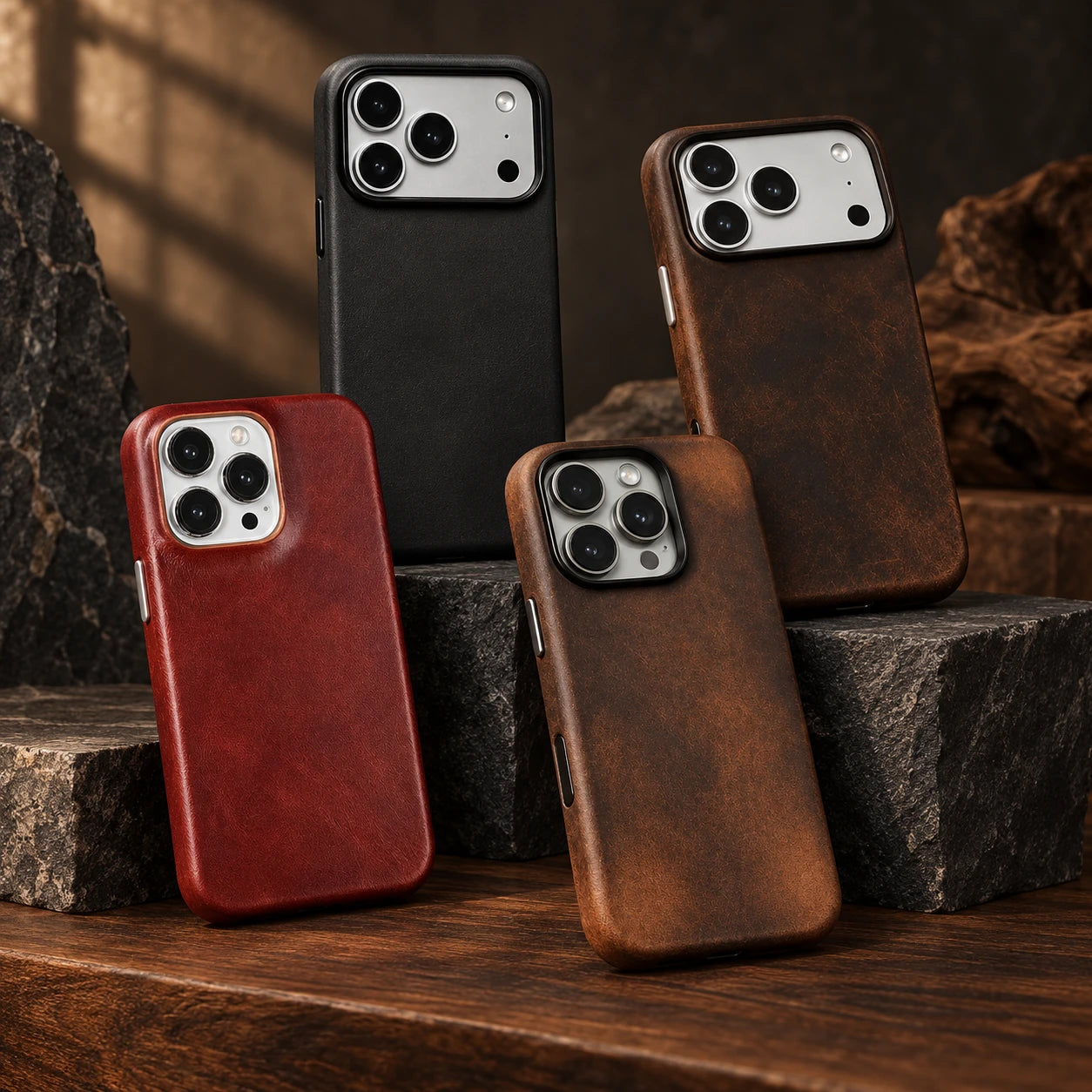



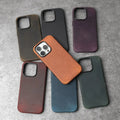



"Ostrich grain" and "croc grain" on a label describe a texture, not an animal. The pattern of an ostrich or a crocodile skin has been pressed into another material. That material can be real cowhide, or it can be a synthetic.
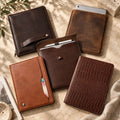
This guide explains what an embossed grain is, how it is made, how to tell it from the real skin, and how the two textured pieces we sell differ: the Deruta, which is cowhide, and the Faenza, which is vegan leather.
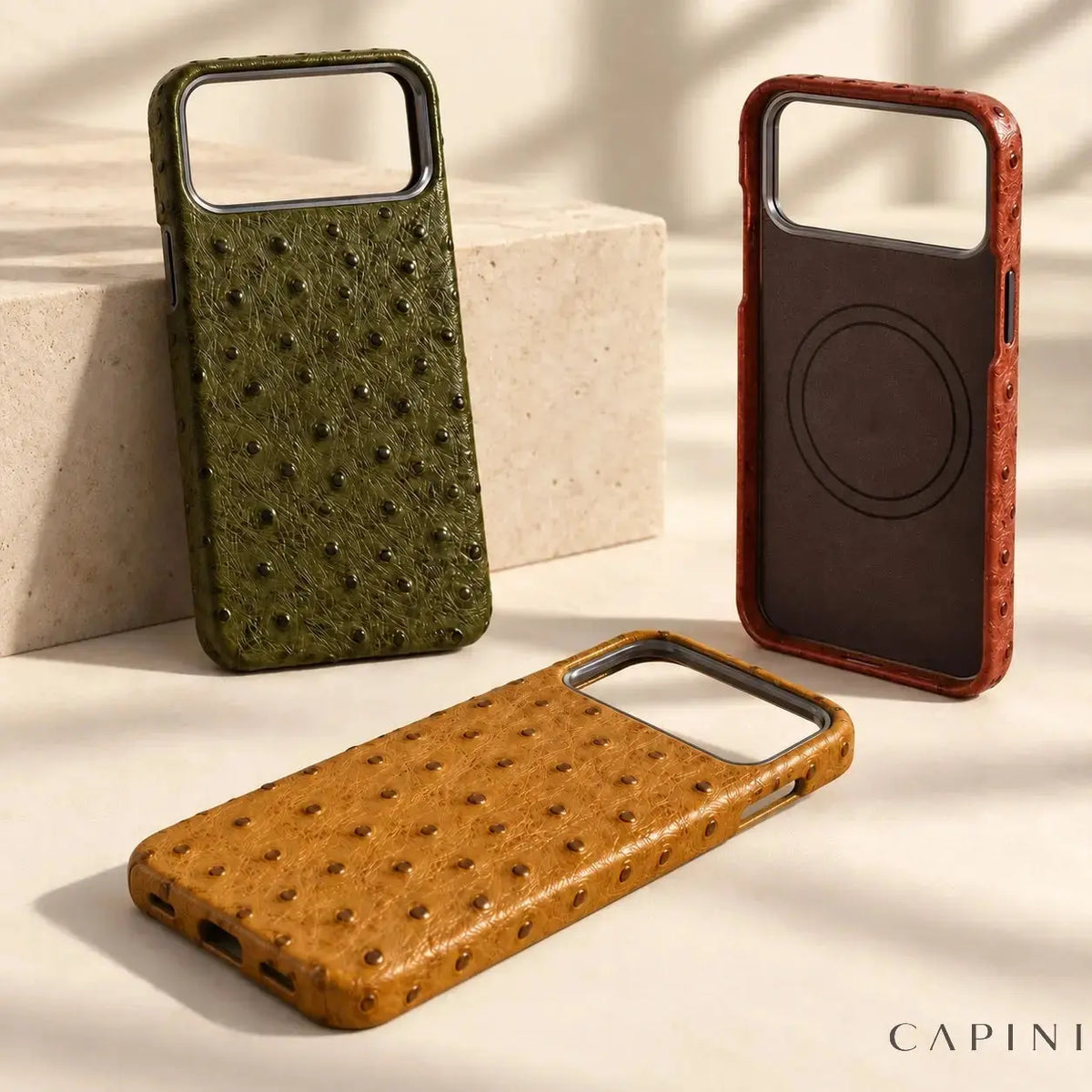
Ostrich grain and croc grain are patterns pressed into a material with an engraved plate or roller, usually with heat and pressure. They imitate the skin of an ostrich or a crocodile; they are not that skin. What matters is the material underneath. Our Deruta phone case is cowhide embossed with an ostrich grain. Our Faenza iPad folio is vegan leather, a synthetic, pressed with a croc grain.
- "Grain" is the outer surface of a hide. Its pattern of follicles or scales is specific to each animal species.
- An embossed grain is a pattern pressed in afterwards. It copies a species' look on a different material.
- "Ostrich grain" or "croc grain" alone tells you nothing about the base. Read what the material is.
- The Deruta is cowhide with an embossed ostrich grain. It contains no ostrich.
- The Faenza is vegan leather (synthetic) with a pressed croc grain. It contains no hide of any kind.
What does "ostrich grain" or "croc grain" mean?
Start with the word grain. In the leather trade it has a precise meaning. The Leather Working Group's list of definitions, aligned with ISO, describes grain as the outer side of the leather once the hair and epidermis have been removed, "characterised by follicles from hair or wool, feather follicles or scales, specific to each animal species".

So every animal leaves its own signature on the surface. A cow leaves hair follicles. A bird such as the ostrich leaves feather follicles. A reptile such as the crocodile leaves scales.
When a product says "ostrich grain" or "croc grain", it borrows that signature. The Deruta page calls its pattern "the raised follicle pattern, pressed into full cowhide". The word grain describes the look. It does not tell you which animal, if any, the material came from.
How is a grain pattern embossed?
Embossing raises a pattern on a surface with engraved rollers or plates, usually with heat and pressure. That is how the conservation dictionary Bookbinding and the Conservation of Books (Etherington and Roberts) describes it for leather. The same entry notes that the patterns often imitate animal grain.

The process works on more than one material:
- On leather. A plate presses a new pattern into the surface of a hide. The leather underneath stays leather.
- On synthetics. Synthetic leather is usually a polyurethane film bonded to a fabric. A chemical maker's technical bulletin (Sanyo Chemical) describes the film being formed on a release paper, which also transfers its grain, and then bonded to a woven, knitted or nonwoven fabric.
Either way, the pattern is made by a tool, not grown by an animal. The Faenza page says it plainly: its croc grain is "pressed into vegan leather, not grown".
Is embossed leather real leather?
It can be, and it can also not be. The pattern is only the top. The answer depends on what it is pressed into.
The ISO-aligned definition used by the Leather Working Group says leather is hide or skin of animal origin, with its original fibrous structure more or less intact, tanned so that it does not rot, and with any surface coating no thicker than 0.15 mm. A polyurethane sheet on a fabric backing is not leather, however convincing the grain.
Here is how our two textured pieces sit against that line:
| Product | Base material | Pattern | Animal hide | Colours | Fits |
|---|---|---|---|---|---|
 Deruta |
Cowhide (real leather) | Embossed ostrich grain | Yes, cow. No ostrich. | Cognac, Amber, Terracotta, Olive, Teal, Plum | iPhone 13 Pro to iPhone 18 Pro Max (see the selector) |
 Faenza |
Vegan leather (synthetic) | Pressed croc grain | No | Brown, Black | iPad mini 8.3" to iPad Pro 13" (see the selector) |
One more honest detail. The Deruta page describes the hide as cowhide. It does not call it full-grain, so we do not either. Full-grain means none of the surface has been removed; a pressed pattern changes that surface by design. The dictionary entry above also notes that embossing is sometimes a way to give a less expensive skin the look of a finer one. If full-grain matters to you, our guide to full-grain vs top-grain vs genuine leather explains the labels.
How can you tell real ostrich or crocodile from an embossed grain?
You rarely need to, because an honest label tells you. When it does not, four checks help:

- Read the material line, not the name. "Ostrich grain", "croc effect" and "croc-embossed" all describe a pattern. Look for the base: cowhide, vegan leather, PU.
- Look for repetition. An embossed pattern comes from an engraved plate or roller, so the same arrangement can repeat across the surface. A real skin varies from one area to the next.
- Look at the back or an edge. Leather shows fibres. A synthetic usually shows a fabric backing.
- Ask about paperwork and price. The Deruta page notes that real ostrich hide costs several times as much and comes with paperwork most people would rather avoid. A real skin at a low price deserves questions.
On our pieces you do not have to guess. The Deruta page says "We say embossed and not ostrich, because that is what it is". The Faenza page calls its material "vegan leather with the grain pressed in: no animal hide". It is synthetic.
Embossed cowhide or embossed vegan leather: how do they age?
This is where the base material shows. The pattern looks similar on day one. A year later, it does not.

- Embossed cowhide changes. The Deruta page says you get the texture "on leather that ages like the cowhide it is". Leather reacts to hands, light and use, and darkens over time. Our article on leather patina explains how that happens.
- Embossed vegan leather stays. The Faenza page says vegan leather "keeps its colour, its shape and its pattern, and wipes clean", and that it will not build a patina the way hide does.
Neither is better in itself. If you want a surface that records how you use it, choose cowhide. If you want the croc pattern to look exactly as it did when it arrived, the synthetic does that. Our comparison of leather, Alcantara and vegan leather goes further.
Why choose an embossed grain at all?
Three reasons come up most often.

- Grip. The raised dots of an ostrich grain give the hand something to hold. The Deruta page lists "raised follicle texture with real grip".
- Colour. A texture catches light, so strong colours read with depth. The Deruta comes in plum, teal and terracotta as well as cognac, amber and olive.
- No skin from those animals. You get the look without an ostrich or a crocodile, and without their price.
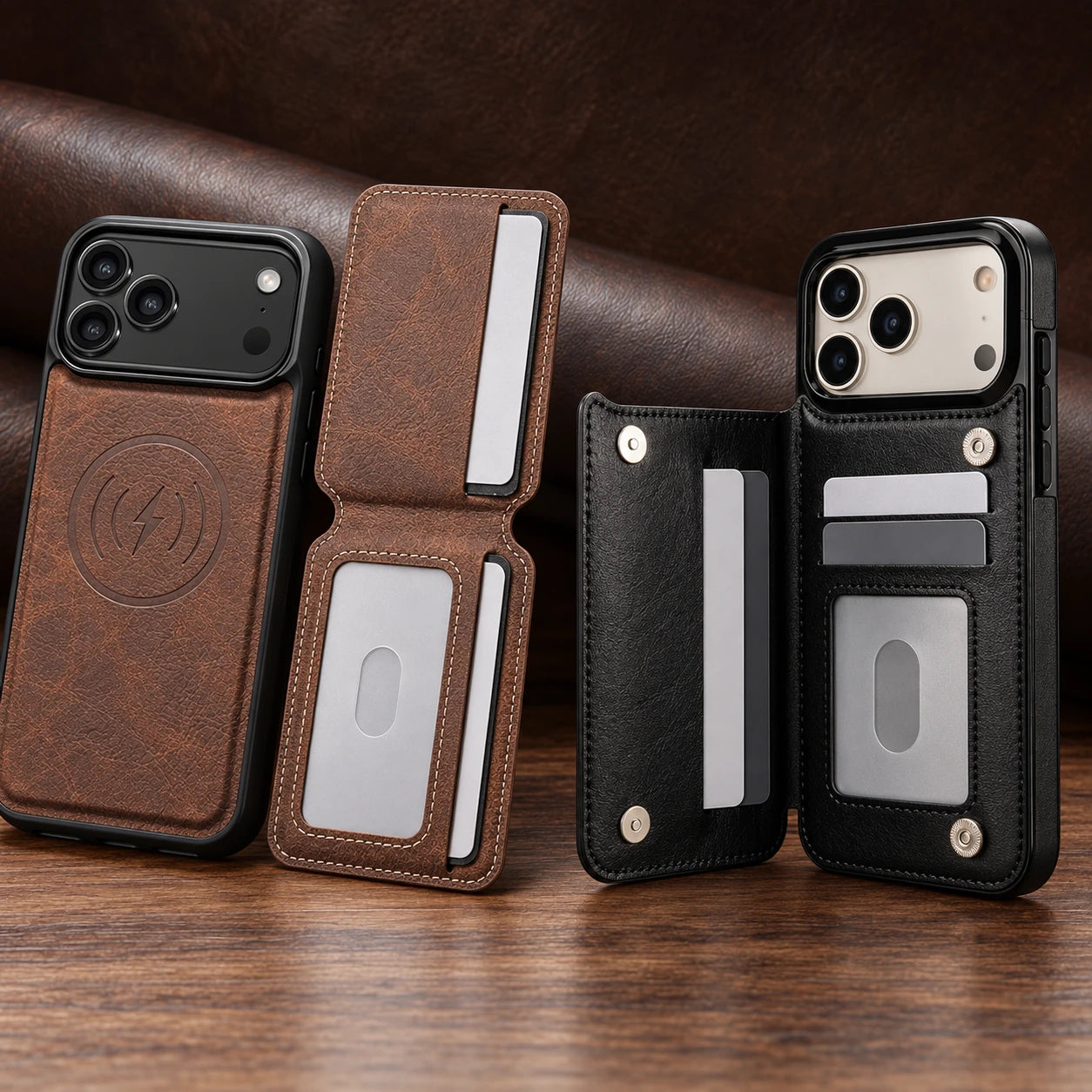
The two pieces also do different jobs. The Deruta is a phone case with a magnetic ring for MagSafe charging and accessories, a raised bezel around the camera and an open port cutout. The Faenza is an iPad folio: the iPad clips into a soft black shell, and the cover folds back into a stand, held by grooves inside the cover.
How do you care for an embossed surface?
A raised pattern has one quirk: dust settles in the low points. Beyond that, follow the base material.

- Deruta (cowhide): wipe with a dry, soft cloth. The page notes that the raised grain holds a little more dust than a smooth surface, and that a soft brush clears it. Keep it away from standing water and prolonged direct sun.
- Faenza (vegan leather): wipe with a soft, slightly damp cloth. Keep it away from solvents, alcohol and long hours in direct sun.
Do not feed a synthetic with leather balm: it has nothing to absorb it. For the Deruta and our other leather pieces, our leather care guide covers the rest. Browse more synthetic pieces in our vegan leather collection, or see all our iPad cases.
Frequently asked questions
Is the Deruta made of ostrich leather?
No. It is cowhide embossed with an ostrich grain. The pattern imitates ostrich skin; no ostrich is used.
Is the Faenza real leather?
No. It is vegan leather, a synthetic material, with a croc grain pressed into it. It contains no animal hide.
What is the difference between "croc grain" and crocodile leather?
Crocodile leather is the tanned skin of the animal. Croc grain is a pattern of scales pressed into another material, such as cowhide or a synthetic.
Does embossed leather develop a patina?
Embossed cowhide changes with use, as leather does. Embossed vegan leather keeps its colour and pattern and does not build a patina.
Does the Deruta work with MagSafe?
Yes. Its page lists a magnetic ring for MagSafe charging and accessories, so it charges without coming off.
Which devices do they fit?
The Deruta fits iPhone models from the 13 Pro to the 18 Pro Max, chosen in the selector. The Faenza fits iPads from the iPad mini 8.3" to the 13-inch iPad Pro, each with its own shell.
Written by the Capini Firenze team. We work with these materials every day and update this guide when our materials change.

Leave a comment
This site is protected by hCaptcha and the hCaptcha Privacy Policy and Terms of Service apply.